

Freight and Logistics Market Set to Exceed USD 11.39 Trillion by 2035 with E-Commerce and Supply Chain Expansion
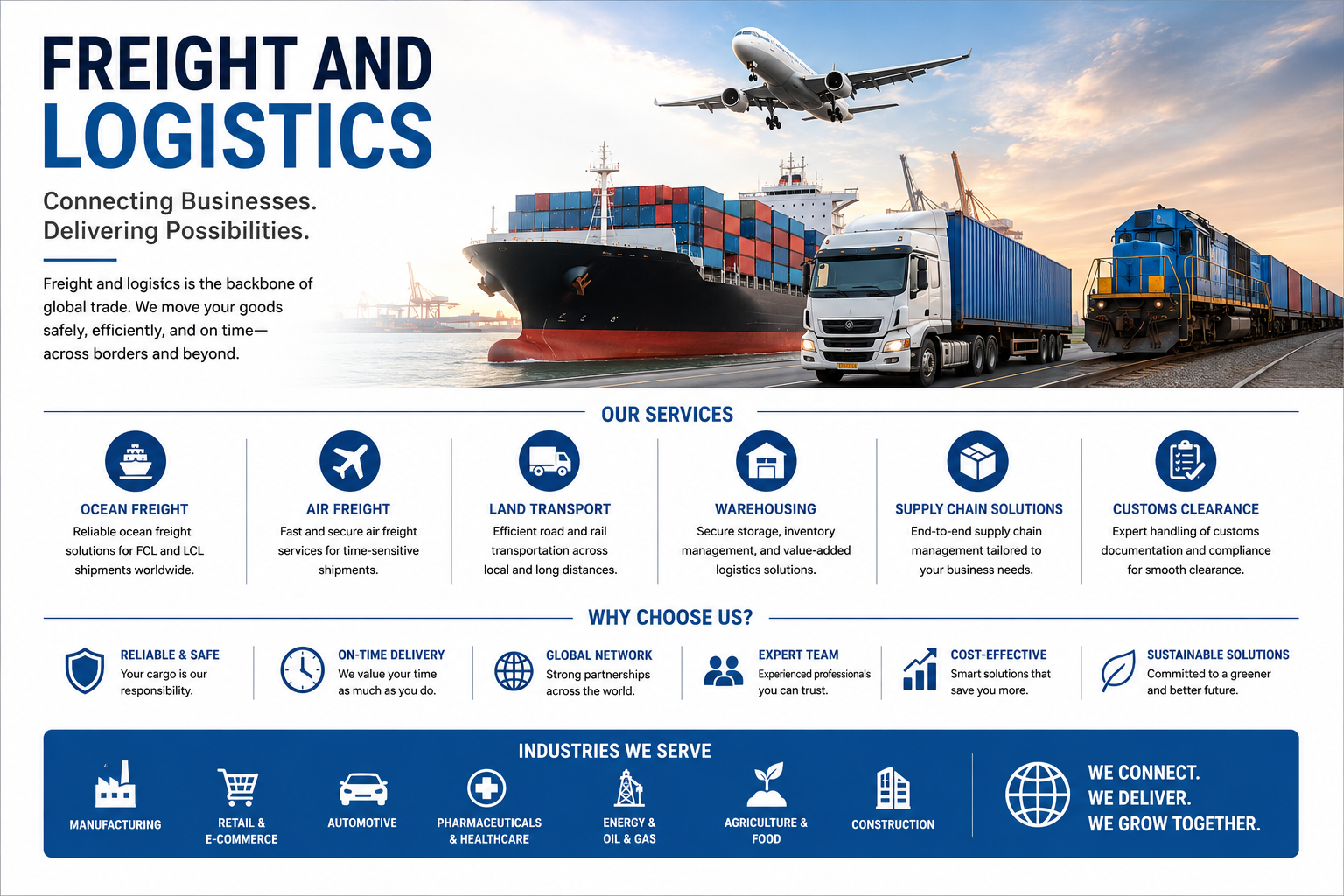
freight and logistics market
Asia-Pacific leads the Freight and Logistics Market at an estimated 43% share, backed by sustained infrastructure spending across China, India, and ASEAN.
GA, UNITED STATES, July 6, 2026 /EINPresswire.com/ -- The global freight and logistics industry stands at an inflection point. After navigating pandemic-era disruptions, port congestion, and supply chain reconfigurations, the sector is now entering a phase of sustained expansion driven by digital commerce, massive infrastructure investment, and the fundamental rewiring of global trade flows. According to a comprehensive report by Market Research Future (MRFR), the freight and logistics market was valued at USD 6.81 trillion in 2025 and is projected to reach USD 7.17 trillion in 2026, ultimately climbing to USD 11.39 trillion by 2035 at a compound annual growth rate (CAGR) of 5.28%. This trajectory reflects not merely a recovery, but a structural transformation in how goods move across borders, continents, and urban centers.The E-Commerce Engine: Parcel Volumes Redefine Last-Mile Economics
The most visible force reshaping the freight and logistics market is the relentless surge in e-commerce parcel volumes. Global e-commerce sales crossed USD 6.3 trillion in 2024 and are projected to surpass USD 8 trillion by 2027. Every incremental billion dollars in online retail spending generates an estimated 12 to 15 million additional parcel shipments annually, loading last-mile and middle-mile networks with unprecedented volume density. This pressure is pushing carriers to expand automated sortation capacity, deploy micro-fulfillment centers in urban cores, and reimagine delivery networks that were originally designed for bulk business-to-business shipments rather than fragmented consumer parcels.
The Courier, Express, and Parcel (CEP) segment, valued at approximately USD 820 billion in 2025, has become the most dynamic function within the broader logistics ecosystem. Domestic parcels currently account for roughly 63% of CEP revenue, but international services are growing at the fastest clip. The Universal Postal Union recorded 22% growth in international small-packet volumes between 2022 and 2024, fueled by regulatory simplification such as the European Union's Import One-Stop-Shop (IOSS) for VAT. Express integrators are responding with dedicated international sort hubs and customs-bonded warehousing, expanding the forwarding and CEP segments within the freight and logistics market.
Download Report Sample Copy with TOC: https://www.marketresearchfuture.com/sample_request/8698
Infrastructure Modernization: The Physical Backbone of Growth
While e-commerce drives demand, infrastructure investment determines whether that demand can be met efficiently. Governments across Asia and the Middle East are channeling over USD 1.4 trillion into port, highway, and rail corridor investments during the current decade, creating fresh capacity that pulls freight volumes upward. India's PM Gati Shakti National Master Plan integrates infrastructure projects with a total estimated investment value exceeding USD 1.2 trillion, targeting a reduction in logistics costs from 14% of GDP to 8% by 2030. China's "New Infrastructure" program continues to prioritize smart ports, high-speed rail freight, and AI-integrated logistics hubs with multi-billion dollar commitments.
These investments are instrumental in reducing transit times and lowering logistics costs, unlocking previously underserved inland regions. India's Dedicated Freight Corridor project will add 2,800 kilometers of high-speed rail freight capacity by 2028, while China's Belt and Road corridors continue to reshape Eurasian trade patterns. The European Commission has allocated EUR 25.8 billion under the Connecting Europe Facility (2021–2027) for cross-border transport corridors, reinforcing the continent's intermodal infrastructure.
Nearshoring, Friend-Shoring, and the Rewiring of Trade Routes
The geopolitical realignment of supply chains is creating new freight corridors and reshaping established ones. The USMCA trade framework has deepened cross-border manufacturing integration between the United States and Mexico, with nearshoring tailwinds changing U.S.-Mexico freight lines and contributing to North America's USD 1.50 trillion share of the global market. Mexico's Interoceánico Corridor is positioning the Isthmus of Tehuantepec as a Pacific-Atlantic land bridge alternative to the Panama Canal, while U.S. Class I railroads invested USD 25 billion in network maintenance and capacity additions during 2023–2024.
In Europe, the post-Brexit customs environment has accelerated digitization efforts, with the United Kingdom posting a 5.08% CAGR as it adapts to new trade documentation requirements. The ASEAN Regional Comprehensive Economic Partnership (RCEP) is lowering tariffs and harmonizing rules of origin, accelerating intra-regional freight flows and supporting the region's 6.05% CAGR. Even Sub-Saharan Africa is emerging as a frontier market, with the African Continental Free Trade Area (AfCFTA) expected to raise intra-African trade by 52% by 2030, generating significant new freight demand.
Technology: The New Cost Equation
Technology is altering the fundamental cost structure of logistics operations. Autonomous yard-management systems, real-time visibility platforms, and AI-driven demand sensing are replacing human warehouse picking and legacy paper-based customs clearance. Digitization of logistics operations can lower total landing costs by 15–25%, according to industry estimates. The EU's new Combined Transport Directive, which extends intermodal shift incentives through 2030, is further bolstering this policy push.
Digital freight brokerages—Uber Freight, Convoy's technology successors, and Asia-based entrants like Blackbuck—are aggregating fragmented trucking capacity onto centralized platforms. By 2032, platform-intermediated loads could represent 30% of North American truckload volumes, reshaping pricing transparency and carrier-shipper dynamics. Real-time shipment data spanning ETA predictions, carrier performance scores, and carbon intensity metrics now carries standalone commercial value, with platforms like project44 and FourKites selling anonymized benchmark datasets to shippers and insurers.
Buy Now: https://www.marketresearchfuture.com/checkout?currency=one_user-USD&report_id=8698
Autonomous Trucking and the Labor Challenge
The freight and logistics market faces a persistent structural headwind: chronic driver and labor shortages. The American Trucking Associations estimated a shortfall of 82,000 truck drivers in the U.S. alone by end-2024, with the gap projected to widen to 160,000 by 2031. Europe faces similar pressures, with the International Road Transport Union reporting that 40% of the continent's commercial drivers are over 55. Rising wages compress margins and slow fleet expansion, acting as a brake on growth.
Autonomous and semi-autonomous trucking corridors offer a potential long-term solution. Regulatory sandboxes in Texas, Arizona, and Germany's A9 autobahn corridor are clearing the path for driverless line-haul operations. Aurora Innovation and Daimler Truck plan commercial autonomous services on the Dallas–Houston lane by 2027, with early adopters potentially reducing per-mile labor costs by up to 40%. However, the transition requires massive capital investment and regulatory coordination that will unfold over years rather than months.
Sustainability and the Green Freight Transition
Environmental compliance is becoming a competitive differentiator rather than a cost burden. The EU's Corporate Sustainability Reporting Directive (CSRD) requires large companies to disclose Scope-3 logistics emissions starting in 2026, making carrier carbon performance a procurement criterion. Green bonds earmarked for low-emission fleet conversions and energy-efficient warehouses raised USD 8.2 billion globally in 2024, with the EU's Taxonomy Regulation classifying zero-emission freight vehicles as "substantially contributing" activities that unlock preferential capital.
Fleet electrification is accelerating. The International Energy Agency's Global EV Outlook indicates that electric heavy-duty truck registrations will exceed 500,000 units annually by 2030, while green-hydrogen refueling corridors are being piloted in Germany, the Netherlands, and California. DHL Group has announced a EUR 2 billion investment in electrifying its European last-mile fleet, targeting 60% electric vans by 2030. Operators who align fleet renewal timelines with green-bond issuance windows can lower their weighted cost of capital by 50 to 80 basis points.
Regional Dynamics: Asia-Pacific Leads, but Growth Is Global
Asia-Pacific holds approximately 43% of the freight and logistics market share, the largest of any region, and registers the fastest CAGR at 5.92%. China's dominance in manufacturing, e-commerce, and port infrastructure anchors this position, while India's Gati Shakti program and expanding BPO sector add momentum. Europe accounts for roughly 24%, supported by intra-EU trade density and green corridor investments. North America contributes 22%, buoyed by nearshoring and cross-border manufacturing freight. South America and the Middle East & Africa, though smaller, are growing rapidly at 5.52% and 5.65% respectively, driven by agri-commodity exports and logistics hub investments.
Saudi Arabia's NEOM and Oxagon logistics zones, backed by over USD 16 billion in committed investment, aim to create a next-generation freight hub linking Asian and European trade lanes. Brazil's Santos–Guarulhos logistics corridor is receiving BRL 14 billion in public and private capital for port deepening and road widening through 2029.
Competitive Landscape: Consolidation Meets Fragmentation
The freight and logistics market is paradoxically both fragmented and consolidating. Hundreds of thousands of players worldwide compete for share, with the top five operators jointly accounting for an estimated 12–16% of overall market revenue. Yet consolidation at the top has gathered pace. DSV's EUR 14.3 billion acquisition of DB Schenker in September 2024 created the world's largest logistics company by forwarding revenue, signaling a scale-driven competitive dynamic among global integrators.
Major players include DHL Group, Kuehne + Nagel International AG, DSV A/S, UPS Supply Chain Solutions, FedEx Corporation, A.P. Moller-Maersk, XPO Inc., C.H. Robinson Worldwide, Nippon Express Holdings, and J.B. Hunt Transport Services. Each is pursuing a distinct strategy: DHL as the global integrator with the widest geographic footprint; Kuehne + Nagel as the premium forwarding leader focused on digital tools; DSV as the scale consolidator with the strongest M&A track record; and Maersk as the ocean-to-door integration specialist.
Looking Ahead: The Logistics Market of 2035
By 2035, the freight and logistics market will bear little resemblance to its current form. AI-orchestrated supply networks will shift logistics planning from reactive to anticipatory, with an estimated 45% of supply chain decisions autonomously executed by 2028. Generative AI and digital twins will compress planning cycles from days to minutes. Micro-fulfillment centers inside urban perimeters—often repurposed retail or parking structures—will enable same-day delivery using electric cargo bikes and light EVs. Cold-chain expansion for pharmaceuticals and food will add a significant high-margin segment, driven by the rise of temperature-sensitive biologics and personalized medicine.
Read More: https://www.marketresearchfuture.com/reports/freight-and-logistics-market-8698
The sector's growth from USD 6.81 trillion to USD 11.39 trillion is not merely a function of volume expansion. It reflects a fundamental elevation in the strategic importance of logistics—from a back-office cost center to a front-line competitive advantage. Organizations that invest in data-driven visibility, compliance-ready green architectures, and AI-augmented operational workflows are positioned to capture disproportionate growth in an industry that moves the world.
Related Report
Dangerous-Hazardous Goods Logistics Market https://www.marketresearchfuture.com/reports/dangerous-hazardous-goods-logistics-market-one-10099
Fifth-party Logistics Market https://www.marketresearchfuture.com/reports/fifth-party-5pl-logistics-market-11673
art logistics market https://www.marketresearchfuture.com/reports/art-logistics-market-41375
bulk liquid logistic market https://www.marketresearchfuture.com/reports/bulk-liquid-logistic-market-28622
fine art logistics market https://www.marketresearchfuture.com/reports/fine-art-logistics-market-11280
Agriculture Logistics Market https://www.marketresearchfuture.com/reports/agriculture-logistics-market-34896
Market Research Future
Market Research Future
+1 855-661-4441
email us here
Legal Disclaimer:
EIN Presswire provides this news content "as is" without warranty of any kind. We do not accept any responsibility or liability for the accuracy, content, images, videos, licenses, completeness, legality, or reliability of the information contained in this article. If you have any complaints or copyright issues related to this article, kindly contact the author above.
